A Q&A with Abner Chou
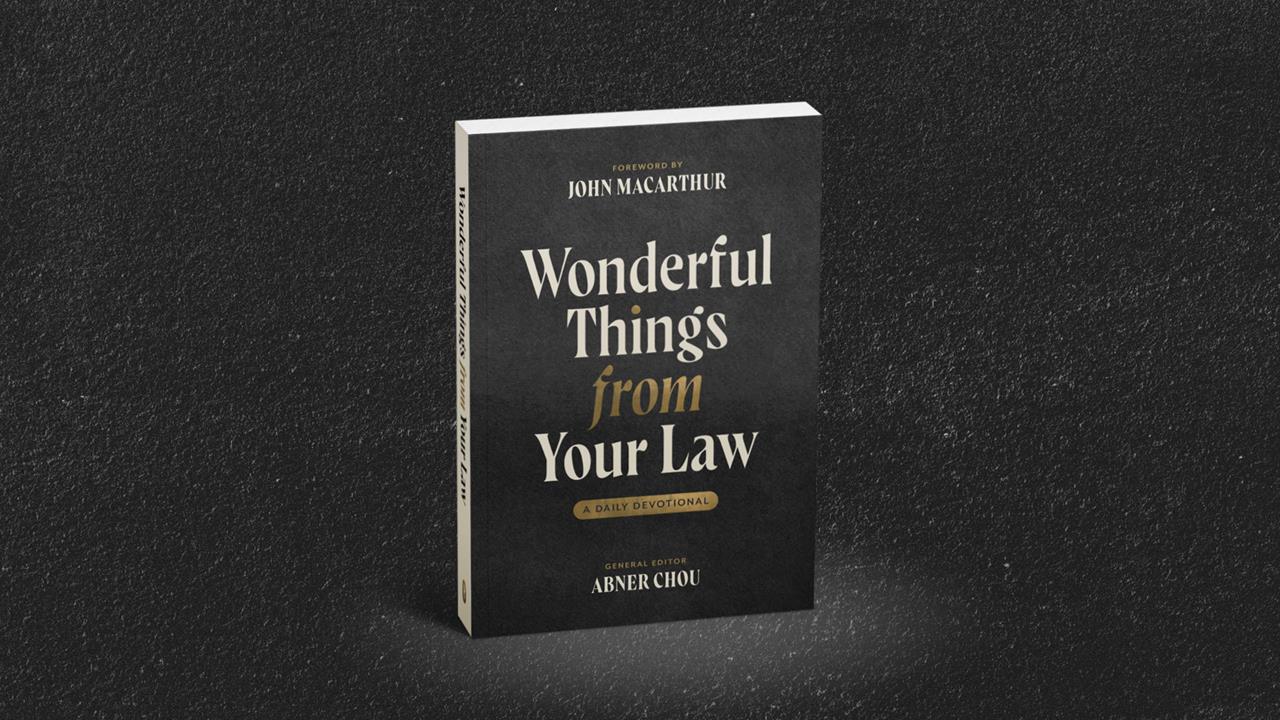
What is Wonderful Things from Your Law?
Wonderful Things from Your Law is a daily devotional named after a phrase in Psalm 119, “Open my eyes, that I may behold wonderful things from Your Law.” In Scripture, “wonderful things” describe God’s work of creation, God’s work in the Exodus, God’s deliverance of Israel, and God’s sustaining of Israel in the wilderness. All these powerful, supernatural acts are called “wonderful things.”
Then, Psalm 119:18 says that there are “wonderful things in Your Word.” That kind of power that creates, defines, and determines is in the Word of God itself. So, this book is a devotional that both helps you to understand wonderful things in God’s Word and teaches you by showing the connections and definitions of words in Scripture.
What is the benefit of a daily devotional for personal use in the Christian life?
It’s very important to be in the Word of God every single day, and as Psalm 1 says, we are to meditate on God’s Word day and night. A daily devotional helps give us some structure for doing that. Sometimes we don’t know what we’re going to read next, but with a devotional, there’s a reading planned for each day so we don’t have to make that decision.
We also sometimes need a teacher to help us understand what the Word of God is revealing to us and how it is instructing us. A good daily devotional can help provide insights that encourage you to meditate on God’s Word day and night.
What makes Wonderful Things from Your Law different from other devotionals?
A lot of devotionals give you some great thoughts, insights, and practical applications, but you don’t always see how they connect with Scripture. This book makes sure that every time you are studying the Word of God, you can see the connection between the devotional application and the very words of Scripture.
A great example is the devotional reading in this book about the nature of hypocrisy from Mark 7. There, Jesus reveals the danger of hypocrisy by repeating the word “leave.” If, like the Pharisees, you “leave” the Word of God (Mark 7:8), you then “leave” people to not obey God at all (Mark 7:12). While hypocrisy may have the semblance of godliness, it’s a complete departure from God and His Word. By emphasizing the word “leave,” Jesus exposes the nature of ungodly hypocrisy more vividly so that we never leave God’s Word.
How can I expect to benefit from Wonderful Things from Your Law?
As you read this devotional, you’re going to learn how to do devotions for the rest of your life. This book sets an example of how to read passages in context, identify key words and phrases, and notice connections to other parts of the Bible. As you follow along with this devotional, you will gain practice and experience that strengthen how you study the Bible on your own. That’s part of the book’s whole design.
But on top of that, you’re going to learn some details about theology and about devotional thoughts and applications. Sometimes we can be very generic. We read a passage and just say, “Well, this is wrong, and that’s bad, or that’s good.” And yet, the Bible can provide so much more detail and nuance than that. This book helps us pay attention to all the details of Scripture. And one of the most beautiful things that I think you can gain from this book is a total confidence that every word of God is inspired, every word is perfectly chosen, every word is loaded with theology, and every word is devotional.
How did you decide which passages to include?
Fundamentally, Wonderful Things from Your Law is based upon the insights that have captured the heart of the LSB translators as we worked verse by verse through the text. But in addition to that, we made sure that every single book of the Bible was represented in this devotional. A lot of devotionals may avoid certain books like Chronicles or Song of Songs, but those books are devotional too.
For example, Song of Songs talks about how the individual regards his wife like “choice” fruits (Song 4:13). That word “choice,” as the devotional points out, goes back to only one other passage in the Bible, Deuteronomy 33, which mentions the “choice” things of the land—the “choice” dew and the “choice” produce and the “choice” flocks (vv. 13–16). That imagery points back to the nature of the Garden of Eden. So, Song of Songs is teaching us why biblical marriage is so beautiful—it is a taste of the Garden of Eden. It is a hope, a glimmer, that Eden can be regained. That is something beautiful to meditate on, and it illustrates that you don’t have to avoid any book to have a devotional thought.
So, with Wonderful Things from Your Law, we want to make sure you see that all Scripture is inspired, all Scripture is profitable, and all Scripture is truly devotional.
